
JAW TYPE COUPLINGS


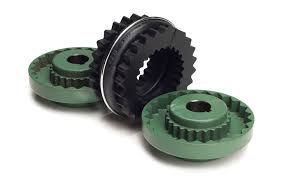
A jaw coupling (also known as a spider coupling) is a type of flexible power transmission coupling used to connect two shafts while damping vibrations and accommodating minor misalignments. It consists of two metallic hubs with interlocking teeth ("jaws") and a central elastomeric insert called a spider.
Key Benefits of Jaw Couplings
-
Fail-Safe Design: Most jaw couplings are designed to be fail-safe. If the elastomeric spider fails, the metal jaws of the two hubs will interlock, allowing for continued, direct power transmission. This prevents sudden system shutdowns and allows maintenance personnel to replace the spider at a more convenient time.
-
Vibration Damping and Shock Absorption: The elastomeric spider acts as a cushion, absorbing up to 80% of system vibrations and protecting sensitive components from shock loads. This reduces mechanical noise and extends the lifespan of connected equipment like motors and gearboxes.
-
Maintenance-Free Operation: Standard jaw couplings require no lubrication and are considered maintenance-free. They eliminate metal-to-metal contact during normal operation, significantly reducing internal wear.
-
Misalignment Compensation: These couplings can accommodate minor angular, parallel, and axial misalignments. Flexible designs typically handle angular misalignment up to 1 degree and parallel misalignment up to 0.015 inches.
-
Electrical Isolation: Because the hubs are separated by an elastomer, jaw couplings can act as electrical insulators, preventing the flow of current between connected shafts.
-
Cost-Effectiveness: Jaw couplings are generally less expensive than other flexible types, such as bellows or disc couplings. Their three-piece design also allows for inexpensive spider replacement rather than replacing the entire unit.
-
Zero-Backlash Options: Specific designs, such as curved jaw couplings with a press-fit spider, offer zero-backlash performance. These are ideal for high-precision motion control and servo-driven systems.
Common Applications
Jaw couplings are widely used in pumps, compressors, conveyors, blowers, mixers, and machine tools due to their robust and simple design.


HRC


Key Types
-
Straight-Jaw: Standard design ideal for moderate torque and general industrial use.
-
Curved-Jaw: Feature a curved profile that can provide zero-backlash performance, making them popular for precision motion control like servo motors.
-
Jaw-In-Shear: A non-fail-safe variant where the spider acts as a "mechanical fuse" to protect equipment during overloads.
KTR Rotex coupling Range

The KTR ROTEX is a torsionally flexible, fail-safe jaw coupling designed for vibration damping and power transmission. It uses a three-part design consisting of two hubs and an internal elastomer ring, known as a spider, made from high-performance T-PUR material.
Key Performance Features
-
Vibration Damping: Effectively reduces shocks and operational vibrations generated by machines.
-
Misalignment Compensation: Compensates for axial, radial, and angular displacements between connected shafts.
-
Durability: The T-PUR® spiders are temperature resistant (standard range -50°C to +120°C) and offer a longer service life than standard polyurethanes.
-
Fail-Safe Design: Even if the spider fails, the metal claws of the hubs ensure continued power transmission.
The KTR ROTEX GS range is a three-part, backlash-free servo coupling designed for precise positioning in high-performance drives. It uses a "construction kit" system, allowing various hub types to be combined within a single coupling size to match specific application needs.
Key Features and Performance
-
Backlash-Free Transmission: Achieved by assembling the elastomer spider under preload between the hub jaws.
-
Vibration Damping: While torsionally stiff, it effectively dampens vibrations and compensates for radial, axial, and angular displacements.
-
Customisable Stiffness: Spiders are available in five different Shore hardnesses (identified by colour), allowing you to tune the coupling's torsional stiffness and damping characteristics.
-
Material Options: Hubs are typically made from aluminium (sizes 5–38) or steel (sizes 42–75) for higher torque requirements.


KTR Polynorm Coupling Range
The KTR POLY-NORM is a torsionally flexible, fail-safe (puncture-proof) shaft coupling known for its exceptionally compact, short-design. It transmits torque via an elastomer ring (spider) placed between the hubs' cams, which serves to dampen shocks and vibrations while compensating for shaft misalignments.
Key Technical Features
-
Fail-Safe Design: The coupling remains functional even if the elastomer fails (metal-to-metal contact), making it "puncture-proof".
-
Compact Construction: It features a particularly short overall length, making it ideal for tight spaces where small shaft distances are required.
-
Maintenance-Free: The coupling requires no lubrication and allows for easy axial "plug-in" assembly.
-
Materials: Hubs are typically made of GJL grey cast iron. The standard elastomer ring is NBR (Perbunan) 78 Shore-A, though high-temperature Viton (FKM) versions are available upon request.
-
Operating Range: Standard temperature resistance ranges from to , with short-term peaks up to .
The KTR POLY-NORM AZR is a torsionally flexible, fail-safe shaft coupling specifically designed to bridge large shaft distances using standard drop-out centre parts. It is primarily used in the pump industry and for compressors, as it allows for the replacement of the elastomer ring without dismounting the driving or driven equipment.
Key Features and Design
-
Torque Range: Supports nominal torques from 0 to 2,900 Nm.
-
Design: Features a standard drop-out centre design for radial assembly and disassembly.
-
Maintenance: Completely maintenance-free and allows for easy axial plug-in assembly.
-
Environmental Resilience: Operates in temperatures from -30 °C to +80 °C, with short-term peaks up to +120 °C.
-
Misalignment Compensation: Effectively absorbs axial, radial, and angular shaft misalignments, as well as shocks and torsional vibrations.
-
Hazardous Areas: Certified according to ATEX standards (Category 2G/2D) for use in zones 1, 2, 21, and 22.


FALK Wrapflex Coupling Range
Falk Wrapflex couplings are non-lubricated, elastomeric couplings known for their "replace-in-place" design, which allows for element replacement without moving or realigning connected equipment. They are widely used to dampen vibration and protect equipment from shock loads.
Key Features & Benefits
-
Simple Maintenance: The non-lubricated polyurethane element requires no periodic greasing, lowering maintenance costs.
-
Reduced Downtime: The "replace-in-place" design eliminates the need to dismantle surrounding equipment, significantly speeding up repairs.
-
Durability: Features a tough polyurethane element that is wear and chemical resistant, with an operating temperature range of -40°C to 93°C.
-
Safety: Flexible elements are retained even after failure, helping to prevent personal injury or further equipment damage.

Flender Neupex Coupling Range
The Flender N-EUPEX is a highly versatile, damping pin coupling designed to compensate for shaft misalignment and absorb critical torsional vibrations within a drivetrain. It is widely established as an industrial standard for connecting motors to gear units in applications such as pumps, fans, and conveyors.
Key Features and Benefits
-
Fail-Safe Reliability: The standard N-EUPEX design is fail-safe, meaning if the flexible elastomers are damaged, the hub parts will come into contact to maintain torque transmission in an "emergency mode" for a short period.
-
Torsional Damping: It uses flexible elements (elastomers) made of synthetic rubber (NBR) that absorb shock loads and move vibrations away from the operating area to protect delicate machinery.
-
Modular Design: The coupling consists of subassemblies that can be easily fitted together. On three-part variants, elastomers can be replaced without moving the coupled machines.
-
Broad Operating Range:
-
Torque: Nominal ranges from 12Nm up to 85,000Nm .
-
Temperature: Standard operation from -50°C to +100°C depending on the elastomer type.
-
Safety: ATEX-certified for use in potentially explosive environments.
-
HRC Coupling Range
An HRC coupling is a semi-elastic, general-purpose shaft coupling designed for use with electric motors to transmit torque while accommodating moderate misalignment. It typically consists of two cast-iron or steel halves (hubs) and a flexible rubber or elastomeric "spider" insert that cushions the connection and absorbs shock.
Key Features & Benefits
-
Fail-Safe Design: If the flexible insert is destroyed, the drive is maintained by the interaction of integral "dogs" (metal teeth) on the flanges.
-
Ease of Installation: Many models utilize Taper-Lock bushes (like the HRC90 or HRC150), which allow for quick fixing and removal using only an Allen key.
-
Misalignment Accommodation: They can handle parallel misalignment (up to 0.5 mm), axial misalignment (up to 1.7 mm), and incidental angular deviations.
-
Low Maintenance: These couplings are virtually maintenance-free and do not require lubrication.
-
Temperature Range: Typically suitable for environments ranging from -40°C to +100°C.
Jaw Coupling Range
SKF jaw couplings are cost-effective, maintenance-free solutions for standard power transmission applications. They are designed to join two shafts, cushion moderate shock loads, and dampen low vibration levels.
Key Features & Benefits
-
Ease of Maintenance: Many models feature a "snap wrap" element that allows for in-situ replacement without moving the hubs or shafts.
-
Misalignment Accommodation: These flexible couplings compensate for incidental angular, offset, and axial misalignments.
-
Durability: Most hubs are manufactured from cast iron, though carbon steel options and various surface treatments (like phosphate coating) are available for corrosion protection.
-
Versatility: Available in a wide range of sizes, from small pilot bore models
Ringfeder TSCHAN Normex & S Type Coupling Range
The Tschan Nor-Mex coupling (now sold under the RINGFEDER brand) is a torsionally elastic, puncture-proof claw coupling used to connect mechanical shafts. It is designed to dampen vibrations and shock loads while compensating for angular, radial, and axial shaft misalignments.
Key Features
-
Vibration & Shock Absorption: Uses an elastic intermediate ring made of Perbunan (Pb) nitrile rubber to cushion impacts.
-
Fail-Safe Design: The "puncture-proof" nature ensures that even if the elastic element fails, the claws will continue to transmit torque, preventing total drive failure.
-
Ease of Maintenance: Many models, such as the Nor-Mex G, allow the elastic ring to be replaced without moving the coupled machines axially.
-
Durability: Highly resistant to oil and capable of operating in temperatures ranging from -30°C to +100°C.
The TSCHAN-S (now rebranded as RINGFEDER TNS) is a torsionally flexible, shock-proof claw coupling used to connect shafts while compensating for misalignments. It transmits torque through an elastic intermediate buffer ring that dampens vibrations and protects machinery from damage.
Key Features
-
Misalignment Compensation: Effectively handles angular, radial, and axial shaft misalignments.
-
Vibration Damping: The elastic buffer ring (often made of Perbunan or Polyurethane) absorbs shocks and shifts dangerous torsional vibrations away from the operational speed range.
-
Fail-Safe Design: It is a "puncture-proof" claw coupling, meaning it continues to transmit torque even if the elastic element fails.
-
Maintenance-Free: Designed for long-term use without regular servicing.
-
Versatile Mounting: Can be used in any direction of rotation or installation position.
TB Woods Sureflex Coupling Range
TB Wood’s Sure-Flex Plus couplings are industry-standard elastomeric couplings designed to transmit torque while protecting equipment from shock, vibration, and misalignment. They feature a 4-way flexing action that accommodates angular and parallel misalignment as well as axial end float.
Key Performance Features
-
High Torque Capacity: The "Plus" design offers a 30% higher torque rating than previous versions, allowing for the use of smaller, more cost-effective couplings in many applications.
-
Maintenance-Free: These couplings require no lubrication and are designed for "fit and forget" operation.
-
Exceptional Dampening: The elastomeric sleeves can wind up torsionally from to to absorb heavy shock loads.
-
Easy Installation: They consist of just three parts (two flanges and one sleeve) and require no special tools for alignment.
Sleeve Material Options
The sleeve material determines the coupling's torque capacity and environmental resistance:
-
EPDM (Black): The most common choice for general industrial use. It operates from -34°C to +135°C .
-
Neoprene (Black with Green dot): Offers better resistance to oil and chemicals compared to EPDM.
-
Hytrel (Orange): A stiff plastic-like material designed for high-torque applications. It can transmit up to 4x the torque of EPDM but has less flexibility.




OVERVIEW
VERSATILE PERFORMANCE
Danum Couplings stocks and sources multiple jaw coupling brands including KTR Rotex, SIT Trasco, Flender Neupex, HRC, Jaw and Tschan-S TNS & Normex range. Our jaw type couplings provide a cost-effective and technically superior solution for industrial power transmission. Engineered for absolute reliability across these leading systems, our components are designed to damp vibrations and absorb shock loads effectively, ensuring the multi-functional durability and longevity of your mission-critical machinery.
Engineering Features & Performance Benefits

Vibration Damping
High-performance elastomeric spiders, featured in our KTR Rotex and SIT Trasco ranges, effectively absorb shock loads and dampen critical vibrations, protecting driven equipment from sudden torque spikes.

Maintenance Free
Requiring no lubrication, the modular three-piece design used in Flender Neupex and HRC type models allows for easy inspection and quick replacement without moving hubs.

Misalignment Handling
Effectively compensates for angular, parallel, and axial misalignments across Tschan S type and other OEM equivalents, extending equipment service life.

Failsafe Reliability
Engineered so that even if the elastomer spider fails, our SIT Trasco and Rotex ranges permit the hub jaws to interlock for continued torque transmission.

Compact Torque Density
Advanced hub geometry across KTR Rotex and Flender Neupex equivalents allows for maximum torque density in space-constrained industrial setups.

Environmental Resilience
From our HRC type to Tschan S type collections, spider materials are selected for chemical resistance and thermal stability from -40°C to +100°C.
Require technical assistance or a custom brand-equivalent quote? Our engineers are available for immediate support.

INDUSTRIAL APPLICATIONS
Jaw Type Couplings are engineered for precision and durability across high-demand industrial sectors. Their fail-safe design and vibration dampening capabilities make them the leading choice for the following environments:
- Centrifugal Pumps and Agitators
- Industrial Fans and Blowers
- Reciprocating Compressors
- Conveyors and Material Handling
- Mixers and Precision Packaging